Tag: Finance

  • Loan Disbursement – All You Need To Know

    Loan Disbursement – All You Need To Know

    Loan disbursement refers to the process of releasing funds to a borrower by a financial institution or lender. It is a crucial step in the lending process, where the borrower receives the approved loan amount. Understanding the loan disbursement process is important for individuals and businesses seeking financing. This article aims to provide a comprehensive overview of loan disbursement, including its purpose, types, requirements, and key considerations.

    Purpose of Loan Disbursement:

    The primary purpose of loan disbursement is to provide borrowers with access to funds for various financial needs. Loans can be used for a wide range of purposes, such as purchasing a home, starting a business, funding education, consolidating debts, or covering unexpected expenses. Loan disbursement ensures that borrowers receive the necessary capital to fulfill their financial goals.

    Types of Loan Disbursement:

    a. Personal Loans: 

    Personal loans are unsecured loans that can be used for any purpose, such as medical expenses, home renovations, or debt consolidation. Loan disbursement for personal loans is typically a lump-sum payment, and borrowers are required to repay the loan through fixed monthly installments over a specified period.

    b. Mortgage Loans: 

    Mortgage loans are used to finance the purchase or refinance of a property. In mortgage disbursement, the lender pays the loan amount directly to the seller or existing lender on behalf of the borrower. The disbursement may be made in a single lump sum or in multiple installments, depending on the loan agreement.

    c. Business Loans: 

    Business loans are designed to provide funding for various business-related purposes, such as expansion, inventory purchase, or working capital. Loan disbursement for business loans can take different forms, including direct deposit to the borrower’s business account, issuance of a business credit card, or line of credit.

    d. Student Loans: 

    Student loans are specifically meant to finance education expenses. Disbursement of student loans is typically made directly to the educational institution to cover tuition fees, books, and other educational expenses. In some cases, the remaining amount after tuition is paid may be disbursed to the student for other educational-related costs.

    Loan Disbursement Process:

    The loan disbursement process involves several key steps:

    a. Loan Application: 

    Borrowers must submit a loan application to the lender, providing necessary information about their financial situation, purpose of the loan, and supporting documentation.

    b. Loan Approval: 

    Upon reviewing the application, the lender assesses the borrower’s creditworthiness, income, and other factors to determine loan eligibility. If approved, the lender provides a loan offer specifying the loan amount, interest rate, repayment terms, and any other conditions.

    c. Loan Acceptance: 

    The borrower reviews the loan offer and, if satisfied, accepts the terms and conditions. This acceptance is often done through signing a loan agreement.

    d. Documentation and Verification: 

    The borrower is required to submit relevant documents, such as proof of identity, income verification, bank statements, and collateral details (if applicable). The lender verifies these documents to ensure their authenticity.

    e. Loan Disbursement: 

    Once all documentation is verified, the lender proceeds with the loan disbursement. The funds are transferred to the borrower’s designated account, or in the case of mortgage loans, directly to the seller or existing lender.

    f. Repayment: 

    The borrower is obligated to repay the loan according to the agreed-upon terms, including the repayment schedule, interest rate, and any other applicable fees.

    Loan Disbursement Requirements:

    To ensure a smooth loan disbursement process, borrowers must meet certain requirements set by the lender. These requirements may include:

    1. Creditworthiness: Lenders assess the borrower’s credit history and credit score to determine their ability to repay the loan. A good credit score improves the chances of loan approval and may result in more favorable terms.
    2. Income and Employment: Borrowers must demonstrate a stable income source and employment history. Lenders typically require proof of income, such as pay stubs or tax returns, to assess the borrower’s ability to make timely loan repayments.
    3. Collateral (if applicable): Secured loans, such as mortgage loans or auto loans, may require collateral. The lender evaluates the value and ownership of the collateral to mitigate the risk of default.
    4. Documentation: Borrowers must provide accurate and complete documentation, including identification, proof of address, bank statements, and tax returns, as per the lender’s requirements

    Key Considerations:

    1. Interest Rates and Fees: Before accepting a loan offer, borrowers should carefully review the interest rates and any additional fees associated with the loan. Comparing offers from different lenders helps in finding the most favorable terms.
    2. Repayment Terms: Understanding the repayment terms is crucial to ensure that the borrower can comfortably meet the monthly payment obligations. Factors such as loan duration, installment amount, and prepayment penalties should be considered.
    3. Prepayment and Default: Borrowers should be aware of prepayment options and penalties, as well as the consequences of defaulting on loan payments. Knowing the potential risks helps borrowers make informed decisions.
    4. Lender Reputation: Researching the lender’s reputation and reading customer reviews can provide insights into their reliability, customer service, and handling of loan disbursement.

    Conclusion:

    Loan disbursement plays a vital role in meeting the financial needs of individuals and businesses. Understanding the loan disbursement process, requirements, and key considerations helps borrowers make informed decisions and navigate the lending landscape effectively. By carefully evaluating loan offers, borrowers can secure the financing they need while ensuring responsible repayment to achieve their financial goals.


  • How to Remove ConServe Collections from Your Credit Report

    How to Remove ConServe Collections from Your Credit Report

    Introduction

    Dealing with collections on your credit report can be a frustrating and challenging process. If you have ConServe Collections listed on your credit report, it’s important to take action to address this issue. In this comprehensive guide, we will outline the steps you can take to remove ConServe Collections from your credit report and improve your creditworthiness. By following these strategies and staying persistent, you can work towards a brighter financial future.

    What is ConServe Collections: 

    ConServe is a debt collection agency that works with various creditors to collect outstanding debts. If you have an account that has been handed over to ConServe for collection, it can have a negative impact on your credit report. This can lower your credit score and make it difficult to obtain credit or secure favorable interest rates. However, you have rights as a consumer and can take steps to address this issue.

    1. Review your credit report: 

    Start by obtaining a copy of your credit report from each of the three major credit bureaus: Equifax, Experian, and TransUnion. You are entitled to one free credit report from each bureau annually. Carefully review the report to identify any accounts in collections, specifically those associated with ConServe.

    2. Validate the debt: 

    Under the Fair Debt Collection Practices Act (FDCPA), you have the right to request validation of the debt. Write a debt validation letter to ConServe requesting proof that they have the legal right to collect the debt and that the amount is accurate. They must provide this information within 30 days. If they fail to validate the debt, you can dispute its accuracy with the credit bureaus.

    3. Dispute inaccuracies: 

    If the debt validation process raises any discrepancies, you can dispute the collections account with the credit bureaus. File a dispute letter with each bureau, providing detailed explanations and supporting evidence for the inaccuracies. The credit bureaus are obligated to investigate your claim within 30 days and remove any inaccurate information.

    4. Negotiate a pay-for-delete agreement: 

    If the debt is valid and accurate, consider negotiating a pay-for-delete agreement with ConServe. Contact them to discuss settling the debt in exchange for removing the collection account from your credit report. Ensure that you obtain written confirmation of the agreement before making any payments. Paying off the debt without a pay-for-delete agreement may not remove the collection from your report.

    5. Seek professional assistance: 

    If you encounter difficulties in removing ConServe Collections from your credit report, you can seek assistance from credit repair companies or credit attorneys. These professionals can help navigate the process, communicate with the collection agency, and work towards resolving the issue.

    6. Monitor your credit: 

    After taking steps to remove ConServe Collections, monitor your credit report regularly to ensure that the negative information has been removed. It’s essential to remain vigilant in protecting your credit and promptly address any new issues that may arise.

    Conclusion:

    While removing ConServe Collections from your credit report can be a challenging process, it’s crucial to take action and work towards resolving this issue. By reviewing your credit report, validating the debt, disputing inaccuracies, negotiating pay-for-delete agreements, and seeking professional assistance if necessary, you can improve your creditworthiness and regain control of your financial future. Stay persistent, maintain good credit habits, and monitor your credit to ensure a clean and accurate credit report.

  • Ignite Entrepreneurship with Small Business Loans

    Ignite Entrepreneurship with Small Business Loans

    When it comes to financing your business, finding the right source of funding can be a challenging task if you’re unaware of where to look. As an entrepreneur running a small business, you have two primary options for obtaining loans: government schemes and private lenders.

    The Pradhan Mantri Mudra Yojana, SIDBI Make in India Soft Loan Fund for MSMEs, and MSME Business Loans for Start-ups in 59 Minutes are a few of the important government programmes. Each private player offers its own application process and terms and conditions, as well as a variety of funding options. 

    Small businesses have several loan options available to them.

    Small business loan programs offered by the government of India

    Small and medium enterprises (SMEs) can apply for business loans from the Indian federal government under a variety of central and state schemes to help them grow. Small businesses can take advantage of the following five government loan programs: 

    Start-up Loans for MSME Businesses in 59 Minutes   

    It is a popular scheme launched in 2018 that offers small-scale industrial loans backed by the central government. In spite of the fact that the actual loan process might take up to 12 days, the loan eligibility is communicated within 59 minutes of the loan application being submitted. 

    The following requirements must be met in order to qualify for a government business loan:

    1. Verification of goods and services tax
    2. Related documents
    3. An account history of at least six months, as well as Know-Your-Customer (KYC) details.

    This scheme offers loans with interest rates starting at 8.50%. In addition, interest rates are determined by the nature of your business and your credit rating. 

    A minimum loan amount of INR 1 lakh and a maximum loan amount of INR 5 crore are available under this scheme. Women entrepreneurs are eligible for a 3% reservation on such loans. 

    Pradhan Mantri Mudra Yojana (PMMY)

    MUDRA is an organization established by the Government of India to provide business finance to micro businesses. Pradhan Mantri Mudra Yojana (PMMY) is a small-scale industry loan administered by MUDRA, with the intention of “funding the unfunded”.  

    Small business loans are available through the PMMY scheme to a wide range of industries and business activities. Loans up to INR 10 lakh can be availed by MSMEs without collateral. Loans under this scheme are commonly referred to as MUDRA loans. Small businesses that are non-corporate (NCSBs) are any type of trading, manufacturing, or service business, including, but not limited to, the following. 

    • Vendors of fruits and vegetables
    • Shops that repair vehicles
    • The artisans
    • Industries with a small size
    • Drivers of trucks
    • Manufacturing units of small size
    • Retailers

    MSMEs are eligible to apply for SIDBI’s Make In India Soft Loan Fund (SMILE).

    The Small Industries Development Bank of India (SIDBI) governs this small business lending scheme. Soft loans are government loans offered at interest rates below market rates by the Government of India through the SMILE scheme.

    Under this scheme, the minimum loan amount is INR 25 lakh. There is a moratorium period of 36 months, and the interest rate starts at 8.36%. Repayments are allowed for a maximum of 10 years. In addition to existing service and manufacturing businesses, new MSMEs can apply for this program. 

    (CGTMSE) is an organization that provides credit guarantees for micro and small enterprises

    The Central Government Small Scale Industries Loan Scheme provides loans to small and medium-sized enterprises. Working capital loans of up to INR 10 lakh are available under this scheme without collateral. After mortgaging your business land or assets, you can avail credit facilities up to INR 1 crore. The programme is intended for newly established or currently operating MSMEs involved in service or manufacturing operations (excluding retail trade), as well as for agricultural and educational institutions and self-help organizations.

    Stand-Up India

    Stand-Up India is a government initiative launched by the Small Industries Development Bank of India (SIDBI) to provide small business loans to women entrepreneurs.
    Small businesses can avail of loans between INR 10 lakh and INR 1 crore under this scheme. Your loan will cover approximately 75% of your business project, and the interest rate is calculated as the bank’s marginal cost of funds-based lending rate (MCLR) + 3% + tenure premium. 
    Those in the manufacturing, trading, or service sectors are eligible for this program.

    Small businesses in India can access loans through private companies

    Business Line of Credit

    This is a flexible business loan that allows the borrower to only pay interest on the money they borrow. As with a credit card, the borrower can draw and repay funds as they need, as long as they do not exceed their credit limit. 

    This type of loan is ideal for small businesses looking to manage their cash flow easier, purchase inventory for a big order, or cover unexpected expenses. These loans are available from banks, non-banking financial companies (NBFCs), and fintech companies without collateral.

    Working Capital Loan

    The purpose of this short-term loan is to generate cash flow to cover day-to-day expenses like advertising, payroll, and inventory purchases. Emergency costs beyond those covered by the line of credit can also be covered by working capital loans. Banks, NBFCs, microfinance institutions, and digital lenders offer these loans, which can be secured or unsecured.

    Term Loan

    A secured loan or an unsecured loan can be used. It is common for small businesses to obtain loans from banks, NBFCs, microfinance institutions, and digital lenders. A borrower’s credit history determines the amount of the loan. Unsecured loans usually last one to five years, while secured loans can last up to 15-20 years.

    In order to support business growth, businesses tend to borrow such loans for capital expenditures. EMIs are usually used for repayment. 

    Merchant Cash Advance 

    Another type of loan that helps small businesses is this one. Lenders assess a borrower’s creditworthiness by assessing their daily debit card sales or digital transactions. A portion of the borrower’s daily debit or credit card sales or digital transactions is then used to repay the loan. For the borrower to manage the payments, cash flow must be sufficient. 

    Invoice Financing

    Factoring is a popular term for this type of loan.

    An invoice is presented to the lender by a small business owner, and the lender pays off the invoice with funds. Business owners usually use this loan when they have a time lag between invoices and payments because the lender fixes the interest rate and tenure in advance. 

    There are other types of loans available, including loans against property, equipment financing, overdraft facilities, and business credit cards. A variety of factors are involved with each of these loans, such as collateral requirements, interest rates, and repayment terms.

    Considering a Startup Business Loan? Here are some things to consider

    The following requirements should be met by startups seeking such a loan:

    • Plan your business in a clear and detailed manner.
    • Your business plan should clearly state how you intend to use the loan amount.
    • Create a chart that outlines the potential returns and growth of the business, along with the objectives and goals.
    • Provide a clear estimate of the funds.

    Eligibility Criteria for Startup Business Loan

    The following are the generic eligibility criteria for startup business loans, which may vary from lender to lender:

    • Applicants should not be younger than 21 years of age and not older than 65 years of age.
    • The applicant must be an Indian citizen.
    • Business plans should be provided by applicants.

    Startup Business Loan Documents

    PhotographsTwo copies (passport-size)
    Proof of IdentityAn Aadhaar Card, a Passport, a PAN card, a Voter’s ID, and Driving License are all required
    Address ProofPostpaid phone bill, passport, driving license, Aadhaar card, voter’s identification
    Age ProofPAN card, passport
    Bank StatementsThe past six months’ Bank statements
    Proof of IncomeA copy of your income tax return, a copy of your salary slip, etc.
    Signature ProofA bank-verified signature, a PAN card, and a passport
    IFSC Code ProofCopy of the front page of the passbook of the same bank account with a canceled/scanned check

    What are the steps for applying for a startup business loan?

    An application for a Startup Business Loan can be submitted in the following ways:

    • By visiting the lender’s website and filling out the form and submitting the required documents, you can apply for the loan online.
    • The loan application form and documents must be submitted to the nearest lender’s branch.
    • For assistance in applying for a startup loan, you can call the lender’s customer service department.

    Features and Benefits of Startup Business Loan

    • Startup business loans do not require collateral or security.
    • There are easy and flexible repayment terms available for startup business loans.
    • It is not necessary to submit a lot of documentation when applying for a startup business loan.
    • The applicant’s bank account is credited immediately with the funds.
    • An applicant’s credit history will determine the interest rate charged by the lender.

    Conclusion:

    It’s important to explore both government and private funding options when seeking funding for your business. Private lenders offer a variety of financing solutions tailored to your specific needs, while government schemes provide accessible and streamlined options. Select the funding source that aligns with your business goals and requirements by conducting thorough research, comparing terms and conditions, and comparing terms and conditions. Your business can be successful if you have the right funding in place.

  • Demystifying Home Loans: A Guide to Financing Your Dream Home

    Demystifying Home Loans: A Guide to Financing Your Dream Home

    Purchasing a home is a significant milestone and a dream come true for many individuals. However, financing your dream home requires careful consideration and planning. For most people, buying a home outright with their savings is not feasible, which is where home loans come into play. In this guide, we will demystify the process of home loans and provide you with a step-by-step financial approach to help you finance your dream home successfully.

    Step 1: Assess Your Financial Situation and Set a Budget:

    The first step in financing your dream home is to assess your financial situation. Take a close look at your savings, income, and expenses to determine how much you can afford to spend on a home. Setting a budget will help you narrow down your options and avoid overextending yourself financially. Consider factors such as the down payment, monthly mortgage payments, property taxes, insurance, and maintenance costs when determining your budget.

    Step 2: Understand Your Home Loan Options:

    Once you have a budget in place, it’s time to explore your home loan options. Research different lenders, including banks, credit unions, and mortgage brokers, to find the best fit for your needs. Understand the types of home loans available, such as fixed-rate mortgages and adjustable-rate mortgages, and compare their terms, interest rates, and repayment options. This will help you make an informed decision about the loan that suits your financial situation and goals.

    Step 3: Prequalify for a Home Loan:

    Before you start house hunting, it’s advisable to get prequalified for a home loan. This involves providing your financial information to a lender who will assess your creditworthiness and give you an estimate of the loan amount you may qualify for. Prequalification gives you a better understanding of your borrowing capacity and helps streamline the home-buying process.

    Step 4: Save for a Down Payment:

    Saving for a down payment is an essential part of financing your dream home. The down payment is a percentage of the total purchase price that you pay upfront. While lenders typically require a minimum down payment, making a larger down payment can lower your monthly mortgage payments and may even help you secure better loan terms. Start saving early and consider using strategies like automatic transfers to a dedicated savings account to reach your down payment goal faster.

    Step 5: Gather Required Documentation:

    When applying for a home loan, you’ll need to provide specific documentation to the lender. This typically includes proof of income, employment history, bank statements, tax returns, and identification documents. Organize these documents in advance to ensure a smooth loan application process.

    Step 6: Fixed vs. Floating Interest Rate

    Home loan interest rates significantly impact the overall cost of the loan. It is important to understand the difference between fixed and floating interest rates before availing a home loan. A fixed interest rate keeps the EMIs constant throughout the loan tenure, which is beneficial when interest rates are expected to rise. On the other hand, a floating interest rate changes with market fluctuations and can be advantageous when interest rates are expected to fall.

    Step 7: Read all the documents carefully

    Before finalizing your home loan deal, thoroughly read and understand all the terms and conditions. Familiarize yourself with regulations related to loan settlement, foreclosure, and prepayment to avoid any misunderstandings. Carefully review all the loan documents before signing them and ensure you are aware of any applicable charges.

    Step 8: Tax Benefits of a home loan

    Home loan borrowers are eligible for several tax deductions. According to the Income Tax Act, of 1961, you can claim deductions on the interest paid on your home loan, the principal amount invested, and charges such as registration and stamp duty fees. Deductions up to Rs. 2 lakhs can be availed for interest payments, while up to Rs. 1.5 lakhs can be claimed under Section 80C for the principal amount. Section 80C also allows you to deduct registration fees and stamp duty as part of your total deduction of Rs. 1.5 lakhs.

    Step 9: Apply for a Home Loan:

    With your finances in order and the necessary documentation in hand, it’s time to apply for a home loan. Submit your application to the chosen lender and be prepared to provide any additional information or documents they may request during the process. It’s essential to be patient and responsive during this stage as the lender evaluates your application.

    Step 10: Review Loan Offers and Choose Wisely:

    Once you receive loan offers from different lenders, take the time to review them carefully. Compare the interest rates, loan terms, fees, and closing costs associated with each offer. Consider seeking professional advice if needed to ensure you understand the terms and select the loan that aligns with your financial goals.

    Step 11: Complete the Loan Process:

    Upon selecting a loan offer, work closely with your lender to complete the loan process. This involves providing any additional documentation required, scheduling a home appraisal, and coordinating with other parties, such as real estate agents and attorneys. Be proactive and responsive throughout this stage to expedite the loan approval and closing process.

    Step 12: Close on Your Dream Home:

    Once your loan is approved, it’s time to close on your dream home. Attend the closing meeting where you’ll sign the necessary paperwork, pay any closing costs or fees, and finalize the purchase. Review all the documents carefully before signing and seek clarification on any terms you don’t understand.

    Conclusion:

    Financing your dream home through a home loan is a journey that requires careful planning and research. By following this step-by-step financial guide, you can navigate the process with confidence and make informed decisions. Remember to stay within your budget, choose the right loan for your needs, and work closely with your lender to achieve your goal of homeownership.

    FAQs on Home loan

    ​What is the pre-approval process?

    Getting pre-approved for a home loan involves applying for a loan and having the lender review your financial information, such as your income, credit history, and debt. Pre-approval gives you an idea of how much you can borrow and helps you determine your budget while searching for a home. It provides an advantage when making offers, as sellers often consider pre-approved buyers more seriously.

    How do I choose the right lender?

    Choosing the right lender involves comparing interest rates, loan terms, fees, and customer service. It’s important to shop around and obtain loan estimates from multiple lenders to find the best fit for your financial situation. You can also seek recommendations from friends, family, or a trusted mortgage broker to help you make an informed decision.

    What is the loan term?

    The amount of time you have to repay the loan is referred to as the loan term. Common loan terms for home loans are 15 years and 30 years, although other options may be available. Higher monthly payments but lower interest costs over the course of the loan are often the result of a loan with a shorter duration.

  • Decoding the Loan Landscape: A Complete Guide to Loan Types

    Decoding the Loan Landscape: A Complete Guide to Loan Types

    Sometimes our aspirations exceed our current financial reach, but fear not, for there’s a solution that can make it all possible. Enter the realm of borrowing, where individuals and businesses alike seize the opportunity to turn their dreams into reality.

    When trust and guarantees intertwine, lenders extend their helping hand, providing the financial boost we need. This lending dance ensues, fueled by a borrowed sum, an interest rate, and a determined duration.

    Institutions like banks and reputable non-banking financial companies (NBFCs) become our allies in this pursuit. Governed by strict policies and renowned for their trustworthiness, they pave the way for a world of possibilities.

    So, whether you’re yearning for a new home, a sleek ride, or a business venture to conquer the world, lending becomes your gateway to success. Step into the realm of possibilities and unlock your dreams with the power of borrowing, offered by the financial wizards of banks and NBFCs.

    Types of Loans

    Based on the Security Provided

    Secured Loans:

    Secured loans require you to provide something valuable as collateral in case you can’t repay the loan. If that happens, the bank can use the collateral to recover the money. These loans have lower interest rates compared to unsecured loans.

    Unsecured Loans:

    Unsecured loans don’t require any collateral. The bank looks at your past relationship, credit score, and other factors to decide whether to give you the loan or not. However, the interest rates for these loans can be higher since there’s no collateral to protect the lender.

    Education Loan:

    An education loan helps you pursue your education, whether it’s for an undergraduate, postgraduate, or diploma/certification course at a respected institution or university. You’ll need to show your admission pass from the institution to get the loan. Education loans are available for both domestic and international courses.

    Personal Loan:

    When you need some extra money for things like repaying debts, going on a vacation, funding a downpayment for a house or car, handling a medical emergency, or buying expensive furniture or gadgets, you can get a personal loan. The lender considers your past relationship with them and your credit score to decide whether to give you the loan.

    Vehicle Loan:

    Vehicle loans help you finance the purchase of two-wheeler or four-wheeler vehicles, whether they’re brand new or used. The loan amount depends on the vehicle’s on-road price and is determined by the lender. You may need to make a down payment since the loan usually doesn’t cover the entire cost. The lender will own the vehicle until you fully repay the loan.

    Home Loan:

    If you’re looking to buy a house or flat, construct a house, renovate or repair an existing house, or purchase a plot for construction, a home loan can provide the necessary funds. The property will be held by the lender until you complete the repayments, and then the ownership will be transferred to you.

    Based on the Pledged Assets

    When your financial needs demand immediate attention, consider the power of pledged loans. These loans are backed by valuable assets, opening a world of possibilities. Let’s explore two popular options:

    Gold Loan:

    In a golden opportunity, lenders offer cash in exchange for your pledged gold, whether it’s jewelry, bars, or coins. The lender carefully assesses the purity and weight of the gold, determining the loan amount. The best part? You can utilize the funds for any purpose you desire. Repayment happens in monthly installments, ensuring that by the end of the tenure, you can reclaim your gold. However, failing to make timely repayments may result in the lender seizing the gold to recover the losses.

    Loan Against Assets:

    Imagine leveraging your assets to unlock financial potential. With loan against assets, you can pledge properties, insurance policies, fixed deposit certificates, mutual funds, shares, bonds, and more. The lender evaluates the value of the assets and offers a loan with a certain margin. As the borrower, it’s essential to make timely repayments to regain custody of your pledged assets at the end of the loan tenure. Defaulting on payments may lead the lender to sell the assets to recover the outstanding amount.

    So, if you find yourself in need of funds, explore the realm of pledged loans. Whether it’s harnessing the value of gold or unlocking the potential of your assets, these loans offer a flexible and accessible solution. Remember, with great borrowing power comes great responsibility—repay on time, and your assets will remain within your grasp.

    Loan Approval: Factors that Matter

    When it comes to loan approval, certain factors hold the key to success. Let’s explore the crucial elements that lenders consider before giving the green light to your application:

    Credit Score:

    Your credit score takes center stage, especially for unsecured loans. It reflects your credit history and the ability to repay debts. Lenders carefully analyze your repayment track record to determine if you’re likely to meet your obligations. Loan approval rests on the lender’s assessment of your creditworthiness.

    Income and Employment History:

    Your income and employment history play a vital role in loan approval. Lenders assess your monthly or annual income, seeking stability and consistency. They gauge your capacity to repay based on your earnings. Even if you’re self-employed, lenders expect a successful business track record and satisfactory turnover.

    Debt-to-Income Ratio:

    Income alone isn’t enough; your debt-to-income ratio matters too. If your existing debt repayments exceed a significant portion of your income, lenders may hesitate to provide a new loan. They want to ensure you have sufficient funds each month to handle both repayments and living expenses. Financial stability is demonstrated by a low debt-to-income ratio.

    Collateral:

    The collateral you offer can influence the interest rate on your loan. Lenders evaluate the market value and security of the collateral you provide. By offering collateral, you enhance the lender’s confidence, potentially resulting in lower interest rates. Unsecured loans, on the other hand, often carry higher interest rates due to the absence of collateral.

    Down Payment:

    Your savings and ability to make a down payment make a positive impression on lenders. A larger down payment signifies your commitment and financial responsibility. It reduces the loan amount required and enhances the lender’s trust in your ability to manage the loan.

    As you navigate the loan approval process, keep these factors in mind. A good credit score, stable income, a healthy debt-to-income ratio, collateral, and a solid down payment can pave the way for loan success. Unlock your financial goals with the right ingredients for loan approval.

    Features, Benefits, and How to Apply

    Loans are your ticket to fulfilling dreams and meeting financial goals. Let’s delve into the exciting features and benefits they offer, along with the simple steps to apply:

    Features and Benefits:

    • Loan Variety: With different types of loans available, you can choose the one that suits your needs and eligibility.
    • Loan Amount: Lenders assess factors like income and repayment capacity to determine the loan amount they can offer you.
    • Tenure and Interest Rate: Each loan comes with a specific repayment tenure and interest rate, tailored to suit your financial journey.
    • Fees and Charges: Banks may apply certain fees and charges to your loan, so it’s essential to be aware of them.
    • Instant Loans: Some lenders provide quick loan disbursal, ensuring you get the funds you need in minutes to a few hours.
    • Interest Rate Determination: Lenders determine the interest rate based on guidance from the Reserve Bank of India.
    • Security Requirements: Lenders may require collateral or a third-party guarantee, depending on the loan type and terms.
    • Equated Monthly Installments: Loan repayments are made through fixed monthly installments over the agreed-upon tenure.
    • Prepayment Options: Some loans allow full or partial prepayment, although there may be penalties associated with it.

    Eligibility for Loan:

    To check your eligibility, consider the following criteria:

    • Decent Credit Score
    • Stable Income
    • Age between 23 and 60 years
    • Assets like Fixed Deposits, Investments, or Property
    • Good Relationship with your Bank
    • Timely Debt Repayment History

    Documents Required:

    Salaried Applicants:

    • Application form with photograph
    • Identity and address proof
    • Last 6 months’ bank account statement
    • Latest Salary Slip
    • Form 16

    Self-Employed Applicants:

    • Application form with photograph
    • Identity and address proof
    • Last 6 months’ bank account statement
    • Proof of business
    • Business Profile
    • income tax returns for the past three years (personal and business)
    • Last three years’ balance sheets and profit/loss statements

    Loan EMI Calculator:

    Stay ahead with a Loan EMI Calculator. Simply input the principal amount, time duration, and interest rate to calculate your monthly payment and total interest.

    How to Apply for a Loan:

    It’s easier than you think to apply for a loan. Follow these simple steps:

    1. Research and choose a lender that aligns with your requirements and eligibility.
    2. Visit the bank branch or their official website to initiate the application process.
    3. Submit or upload the necessary documents and proofs.
    4. The bank will review your application and provide an update within the specified timeframe.

    Now that you’re equipped with the knowledge, take a confident step toward your financial aspirations. Apply for a loan today and unlock a world of possibilities!

  • The 12 Benefits Of Good Credit And How It Can Help You In Your Financial Life

    The 12 Benefits Of Good Credit And How It Can Help You In Your Financial Life

    Credit scores indicate your financial health, creditworthiness, and overall financial health. The importance of building good credit early on cannot be overstated since it is a crucial part of your financial identity. Having a bad credit score can increase the cost of your largest financial purchases while having a good score gives you a competitive edge when applying for loans.

    Many of us define financial freedom as the ability to afford the lifestyle we desire through savings, investments, and cash on hand.

    Different people have different ideas about what “financial freedom” entails. The freedom to buy whatever you want and when you want is one of the definitions of financial freedom. People might feel more relaxed about their finances if they don’t have to worry about their bills or sudden expenses. Some people define it as becoming debt-free, while others may define it as becoming wealthy enough to retire. In spite of the fact that all of these interpretations are somewhat true, they all provide only half-baked solutions. We’ll examine the ‘cash on hand’ portion of that statement and discuss how credit (via loans and credit cards) can be a more efficient way to build financial freedom.

    A borrower’s creditworthiness is determined by his or her ability to repay a loan or credit. There are several ways in which having good creditworthiness can help you become financially independent:

    1. Access to better credit terms: Lenders are more likely to offer you better credit terms if you have good creditworthiness, such as lower interest rates, longer repayment periods, and higher credit limits. In addition to saving you money in interest charges, this will allow you to manage your debt more efficiently.
    2. Ability to secure loans and credit: If you have good credit, you can obtain loans and credit more easily, whether you need a mortgage, a car loan, or a credit card. Your financial goals will be more likely to be achieved if you take this approach, such as buying a home or starting a business.
    3. Improved job prospects: A number of employers check credit scores as part of the hiring process. Having a good credit score may signal to potential employers that you’re reliable and responsible, which could boost your job prospects and potentially lead to higher salaries. Personal credit checks are required for some jobs, such as those in the finance sector or those requiring security clearance. The purpose is to make sure you’re capable of handling finances or that financial difficulties will not make you vulnerable to bribery. There are some jobs that you might not be able to apply for if you have a poor credit score.
    4. A better sense of financial security: Maintaining good creditworthiness demonstrates your ability to manage credit responsibly and reduces your chances of getting into financial trouble. In addition to improving your ability to handle unexpected expenses, this can also make you more prepared to handle emergencies.
    5. Having good credit will lower your interest rates: Lower interest rates are one of the main benefits of having good credit. The interest rate you will pay when applying for a loan, such as a mortgage or credit card, is usually determined by your credit score. Learn how to improve your credit score in a faster way here. Credit scores with higher scores typically attract the lowest rates; less credit-worthy applicants often find their interest rates higher. It is the lender’s responsibility to determine and set the interest rate for each individual. Based on the information provided, the rates are believed to be accurate.
    6. The average interest rate on a personal loan depends on your credit score: Increasing your chances of qualifying for a loan or credit. If you have ever been denied a credit card or loan, you understand how painful it can be. Denial of financing for an important purchase, such as a mortgage or a car, can be a hardship. Getting denied other loans, such as private student loans that can help many people afford college, can be devastating. In addition to better credit scores, applicants are more likely to be approved. Obviously, lenders consider your credit score in addition to other factors, but it is important.
    7. Larger Credit Card and Loan Limits: You’ll be able to take out a mortgage in some high-cost areas if you have a good credit score, such as a jumbo loan. Additionally, you may be eligible for higher credit card limits. An Experian study found that the average Baby Boomer had a credit score of 731 and a credit limit of nearly 32,820,60 INR. In contrast, young Millennials had a lower credit score of 668 and a smaller credit limit of around 16,410,30 INR. As credit scores are influenced by the length of your credit history, Baby Boomers have had more time to build good credit than earlier generations.
    8. Rewards from credit cards that are better: The better your credit score, the more credit cards you’ll be able to apply for, including cards with higher limits. It is important to have excellent credit in order to be approved for most rewards cards. In addition, to travel rewards cards, you can also earn cash-back rewards cards that earn a percentage back on your spending.
    9. Easier Approval for Rental Properties: No matter whether you plan to buy a house in the near future, it is still important to have a good credit score. In most cases, landlords consider your credit score when deciding whether to rent to you, which is something most people are unaware of. The landlord is more likely to approve you as a tenant if you have a good credit score since an on-time payment history is more appealing to them than someone with multiple delinquencies. If you do not meet these requirements, you may need to pay a larger deposit, agree to a short-term lease, or even have your application denied altogether.
    10. Lower Insurance Rates: Insurance costs can also be reduced if you have good credit. Insurance companies use your credit score to determine whether to accept you as a customer and how much to charge you, despite some officials’ concerns. Those with fair credit (a FICO score between 580 and 669) pay 39% more for auto insurance, according to a study by insuranceQuotes. The situation was even worse for people with poor credit (A FICO score under 580), who paid 103% more.
    11. Avoid Security Deposits on Utilities: When it comes to getting your utilities turned on, a good credit score is important, too. A good credit score will likely lead to your utilities being turned on with a minimum amount of hassle. You may also need a deposit from you if your credit is poor, or even someone to legally agree to pay your bill in case of non-payment, similar to finding a co-signer for a loan.
    12. Negotiating Power on Loan Terms: Better credit scores can lower interest rates, as well as be used as a bargaining chip during mortgage negotiations. Prequalification and comparison of rates with a few lenders will help you achieve this. If your rate estimate is accurate, you can take it around to different lenders to see if they can give you better terms, such as lowering the interest rate even further or waiving loan fees.

    Bottom Line

    The importance of maintaining and building a strong credit profile cannot be overstated, since the credit score is an important component of most lending decisions. In order to prepare for any future loan or rental applications, make sure to improve your credit score if you have a low score. Having good creditworthiness is important for attaining financial independence, as it gives you access to better credit terms, allows you to secure loans and credit, improves your job prospects, and makes life more comfortable.

  • In terms of financial abilities, how do men and women differ?

    In terms of financial abilities, how do men and women differ?

    Most of us picture a man as a businessman, entrepreneur, or self-employed individual.  However, the reality is more balanced.  Women own and operate approximately 20% of Indian MSMEs. Over the past decade and a half, millions of thriving women-owned businesses have been created as a result of bank accounts and credit extensions geared toward women. Through credit or loans, businesses can grow, create more economic value, and jobs, as well as generate returns for the lender. What are the differences between how men and women access and repay loans in this context? Yes, it is.

    In microfinance, small loans (that grow in size over time) are extended to women on the basis of social underwriting, one of the biggest success stories in credit extension to women.  The RBI regulates microfinance loans to women in India, as it does with other types of loans. Those borrowers who are women who are enrolled in the formal credit system. In this sector, default rates have been remarkably low and growth has been strong over the past decade.
    In spite of individual differences, men and women behave differently when it comes to money and finances. The following are some general trends:

    1. Earning:

    Most countries around the world have a significant gender pay gap, with women earning less on average than men. This is influenced by a variety of circumstances, including:

    • Occupational segregation: Most women work in low-paying jobs and industries, whereas men are more likely to work in high-paying fields.
    • Discrimination: Women may face discrimination in hiring, promotion, and pay, resulting in lower wages than men.
    • Unpaid caregiving responsibilities: Women are more likely to take on unpaid caregiving responsibilities, which can make it difficult to work full-time or pursue higher-paying jobs.
    • Negotiation skills: It has been found that women are less likely than men to negotiate their salaries, resulting in lower starting salaries and slower wage growth.
    • Education and experience:
      Women may have less access to education and training than men, limiting their earning potential.

    2. Spending:

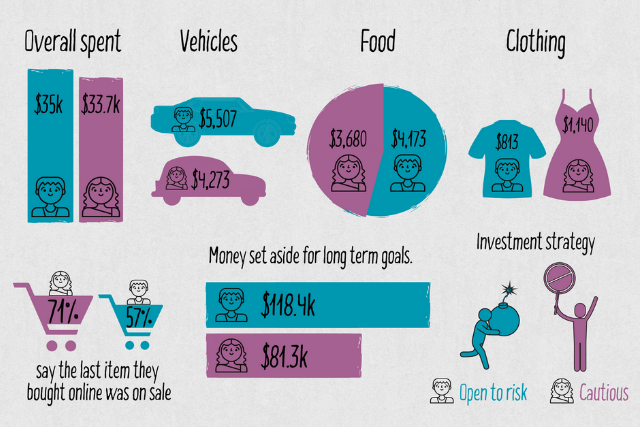
    The female population tends to be more budget-conscious than the male population, preferring to save and spend carefully over making impulse purchases. The tendency of men to spend on luxury items or large purchases is the opposite of that of women.

    3. Investing: 

    Generally, women are more cautious in their investment strategies than men are in terms of taking financial risks and investing in high-risk, high-reward opportunities such as stocks.

    4. Debt:

    According to the CDC, men carry more debt than women, due primarily to increased levels of student loans and credit card debt. Women are more likely to fear the impact of debt on their credit scores and future financial opportunities, while men may be more fearful of the financial burden brought by debt.

    5. Financial fears

    Men and women can experience financial fears, but there may be some differences in the specific fears they experience:

    • Job loss: Both men and women may fear losing their jobs, but men may feel more pressure to be the primary breadwinner and experience greater anxiety.
    • Retirement: Because of gender pay gaps, lower lifetime earnings, and caregiving responsibilities, women may worry that they won’t have enough money for retirement.
    • Emergency expenses: Men and women may worry about unexpected emergency expenses, but women may worry more about paying medical expenses due to their higher healthcare costs and greater likelihood of taking care of children and aging parents.
    • Investing: Women may be more hesitant to invest and take financial risks, which can negatively impact their long-term financial plans.

    6. Financial planning:

    Women tend to seek financial advice and engage in long-term financial planning, while men may rely more on their own intuition.

    7. Negotiation:

    Research shows that men are more likely to negotiate salary and other financial arrangements, while women are more likely to accept the initial offer.

    8. Confidence:

    Men may be more confident in their financial decisions even when they are not well-informed, while women may be more hesitant to take risks and make decisions without feeling fully informed.

    9. Women are more conservative about spending: 

    Business spending by women may be more conservative than by men. Women business owners tend to have lower levels of debt and lower average expenses than their male counterparts, according to studies. When it comes to running a business, women may also prioritize cost-effectiveness and practicality over extravagant spending.

    10. Women are better at self-monitoring their money:

    It may be more likely for women to seek financial advice and engage in long-term financial planning, which could contribute to a greater sense of control and self-monitoring. Additionally, societal expectations and cultural norms may emphasize women’s responsibility for managing household finances, which could affect women’s self-monitoring of money.

    11. Women have lesser default rates than men:

    According to studies, women default on loans at a lower rate than men. A number of factors could contribute to this, including:

    • Taking on fewer loans or loans with lower risk profiles may be more common among women than among men.
    • There is a lower likelihood of women defaulting on their loans due to their lower debt-to-income ratios.
    • Financial advice and guidance may be sought by women more often before taking on a loan, resulting in more informed and responsible borrowing decisions.
    • As a result, women may have more stable employment and income compared to men, which reduces their risk of defaulting on their loans.

    12. Compared to men, women get slightly better returns on their investments:

    The following factors may contribute to this trend:

    • Risk aversion: Women tend to prefer more conservative investments that offer lower potential returns but also lower risks when it comes to investing.
    • Patience: Women often hold onto their investments for a longer period of time and avoid impulsive buying and selling that can negatively affect returns.
    • Diversification: Women may be more likely to diversify their investments across a variety of asset classes and sectors, which can help to minimize risk and optimize returns.
    • Lower trading costs: Women tend to trade less frequently and have lower trading costs than men, which can lead to higher overall returns.

    These are general trends, and attitudes and behaviors toward money and finances may vary greatly among individuals. Approach each person and each relationship with an open mind and a willingness to understand their unique viewpoint.

    FAQs

    1. What is the credit score of a woman compared to that of a man?

    Ans: The average credit score of the two genders is now identical. Men and women carry essentially the same level of credit card debt.

    2. Do women perform better in finance than men?

    According to several studies, women often earn higher returns from investing than men do. According to a recent academic study, ladies outperform men by up to 1% a year when it comes to investing.

    3. Can a husband and wife have different credit scores?

    There is no such thing as marriage credit scores. Credit histories and scores do not merge when you get married. Credit accounts used by your spouse cannot affect you

  • 5 Tips for Efficient Financial Management of your Business

    5 Tips for Efficient Financial Management of your Business

    How To Manage Your Business Finances Efficiently

    5 Ways To Manage Your Business Cash Flow

    Without sound financial management, a company risks losing the workforce required for its expansion, having to cease developing new products, giving up on business development projects, or not being able to afford the equipment it needs to be profitable. This is especially a major risk for any SME.

    In addition to managing ongoing costs like salary, rent, and overhead, business owners also need to think about one-time purchases like making purchases of assets. To maintain stability, security, and longevity, it is crucial to understand how to manage corporate financing effectively.

    Why is it Important to Manage Your Business Finances?

    Many entrepreneurs, whether they are business owners or SME managers, focus on the growth and profitability of the business. Using bank statements, they only track the money. However, a thriving business that expands its activity is not immune to financial issues, particularly since expanding an activity sometimes necessitates tying up more funds (increase in working capital).

    In order to ensure the company’s continued growth, it is crucial to ensure accurate and consistent financial monitoring and to foresee its future developments in addition to activity and profitability indicators.

    The viability and growth of your business depend on your ability to manage your funds. How can the organization’s financial management be improved to analyze needs more accurately and grow? Here are a few suggestions.

    Top 5 Tips to Improve Financial Management

    Be Active in the Management of Your Business

    Anything that is measured improves. For this reason, you must maintain control over your business right away. By doing so, you will be able to comprehend how your company operates, prevent unpleasant surprises, and be aware of the various levers available to grow your company.

    Making the best judgments and achieving your goals as outlined in your business plan will be made easier with effective management of your activity. Complete outsourcing is not advised.

    Establish Sound Financial Habits

    Creating internal financial protocols can help safeguard the financial stability of your company, even if it only involves spending some time reviewing and updating financial data. Monitoring your finances can help you reduce risk or fraud.

    If your business is new, you likely have a restricted budget, little free time, and inadequate infrastructure. That shouldn’t prevent you from implementing a certain internal control, though. If you have employees, this is extremely crucial. Internal controls that are inadequate might result in employee fraud or theft and may put you or an employee in legal trouble if you break certain laws.

    Limit Your Stock to What is Actually Necessary.

    The way you manage your inventory can have a significant impact on the financial health of your company. Unsold and perishable goods will cause financial loss if you are not attentive. Additionally, your storage expenses will be excessively high. You must consequently learn how to optimize your stock holdings.

    Prioritize Credits

    As a firm expands, it frequently has to buy expensive commercial real estate, more insurance, and other necessary assets. Businesses must apply for a loan because the majority of them lack the funds to make purchases.

    However, loans with affordable interest rates demand a strong credit history that proves the company’s financial health. Businesses should make timely payments to their credit lines and pay off their debts to retain a strong credit rating.

    Maintain Healthy Relationships with Suppliers & Customers.

    Cash can be saved by having positive working relationships with customers and suppliers. Offering financial incentives or extra services to consumers who make prompt payments, for instance, might be fascinating.

    Similarly, it can be exciting to work out a deadline extension with a supplier in exchange for timely payment. However, it should not be overlooked that any negotiation, whether with customers or suppliers, requires the participation of two sides.

    Invest in Expansions

    Finally, it’s essential to save money and look for advancement chances. It might enable your company to grow and take a sound financial turn. In fact, business entrepreneurs must always look into the future.

    A small business must establish its willingness to make future investments if it hopes to expand, develop, and recruit the best talent. You can be sure that your clients will value the better service. Employees will then realize that you care about both the business and their careers. In the long run, you will benefit your company considerably more if you merely used your revenues for personal expenses.

    Conclusion

    A healthy and steady financial state is one of the most important cornerstones of a business’s success. To accomplish your goals, including increasing sales, stabilizing cash flow, increasing profits, etc., you must first improve your financial performance.

    It is important to show interest in financial management, whether it is one of your strengths or your weak point. Arm yourself with knowledge and rely on professionals. Nothing will be able to stand in your way if you know how to evaluate the operational and financial health of your company.

  • What Is the Purpose of ECN Number in CIBIL

    What Is the Purpose of ECN Number in CIBIL

    The ECN number in your CIBIL report is a crucial identifier that helps both credit information companies and lenders access your detailed credit history. Located in the top right corner of your report, this number serves as a unique reference for all your credit reports and financial data. The CIBIL report holds vital information about your creditworthiness, including your credit score and history of payments, which is vital when you’re seeking loans or other credit facilities. By examining this number and associated data, lenders can quickly assess the risk of lending to an individual.

    According to the Companies Regulation Act 2005, credit information companies are mandated to maintain and provide access to credit reports for individuals and credit reports for businesses. The ECN number found in the top right corner of the CIBIL report is part of this regulatory framework, which ensures that the credit history provided to lenders is accurate and reliable. When you apply for a loan, you may also be asked to provide this number to the lender to facilitate the recovery process or track your credit report accurately.

    What is an ECN Number & How to Get it?

    When an applicant submits a personal loan application online, the lender needs access to your credit report to assess repayment capacity and the risk of default. All registered lenders follow this process, especially for unsecured loans.

    CIBIL uses the ECN number in CIBIL (also known as the “Enquiry Control Number ECN”) to release the report. An ECN number is a unique nine-digit identifier assigned to every credit report, enabling lenders to efficiently track your credit history and score across millions of reports.

    The ECN Number in CIBIL Reports

    The control number in CIBIL is another term for the ECN number. This control number is a key reference used by lenders to fetch and evaluate an applicant’s credit details. The control number in the report allows lenders to retrieve information about repayment history and credit behavior.

    Why Is the ECN Number Important?

    The ECN number serves several purposes:

    • The ECN helps CIBIL maintain millions of reports in an organized manner.
    • Lenders use the ECN number to access detailed information about your credit history and financial accounts.
    • By securely maintaining your credit history and score, the control number also safeguards your credit score.

    It is confidential to disclose your ECN number, but applicants can obtain it under the Credit Information Companies Regulation Act, 2005. Borrowers can view their ECN at the top right of their credit report or request it via the CIBIL Helpline or website.

    Checking Your Credit Score

    Prospective borrowers can check their credit score online before making a formal loan application. Here’s how to check and get an ECN:

    1. Visit the CIBIL Score Checker or Fullerton India website.
    2. Select ‘Salaried’ or ‘Self-Employed’ based on your profile.
    3. Click ‘Continue.’
    4. Fill in your personal, company, and income details.
    5. Verify your mobile number with an OTP.
    6. Your free credit report and ECN number will be generated instantly.

    The Purpose of Having an ECN Number

    Here’s why having an ECN number is important:

    1. It helps CIBIL manage reports systematically.
    2. Lenders can use the control number to access a borrower’s financial details.
    3. The control number is a safeguard for maintaining your credit history and ensuring secure access to your credit report.

    How to get an ECN number?

    Control numbers are a crucial component of CIBIL’s credit report and history maintenance. Therefore, credit reports and Enquiry Control Numbers are not easily accessible to anyone.

    According to the Credit Information Companies Regulation Act, 2005, you can obtain a copy of your credit report as well as your Enquiry Control Number (ECN) through the Credit Information Company.

    If you have taken out a loan from a bank, you can also ask them to provide you with the ECN number.

    • CIBIL also offers the following methods for obtaining a control number:

    ◦ 1800224245 is the helpline number

    ◦ To submit a written request, visit their website at www.cibil.com 

    • You can obtain your ECN by subscribing to a periodic credit report.

    How To Check Your CIBIL Report?

    Here are the steps you need to follow to do a CIBIL score check free online with your PAN Card:

    1. Go to the official CIBIL website

    2. The top-right corner of your landing page will have an option to ‘Get your CIBIL score.’ Click on it.

    3. CIBIL scores can be checked more than once with a subscription method. In addition, if you only wish to view the score annually, you can skip this step.

    4. The site will ask you for your PAN number, date of birth, gender, email address, and captcha code. Click ‘Proceed to Payment’ once you have completed all the fields and acknowledged the terms and conditions.

    5. There are a variety of payment methods available, which you can choose according to your preferences.

    6. After completing the above step, you will see your CIBIL score.

    You can check your CIBIL score once a year for free on the website. Users with paid memberships can check their credit scores more frequently.

    Conclusion:

    By now, you might have understood the importance of getting an ECN number and its use. With your ECN number, you can access important details about your credit report and check your credit history in detail.

    Frequently Asked Questions

    1. What is the ECN number in the CIBIL report?

    The ECN number (Electronic Credit Number) is a unique identifier in your CIBIL report. It is found in the top right corner of the report and is crucial for tracking and accessing your credit history. This number allows you to access detailed information about your credit report from the credit information companies.

    2. How can I obtain my ECN number from the CIBIL report?

    You can obtain your ECN number by downloading your CIBIL report directly from the CIBIL website. Once you access the report, you will find the ECN number in the top right corner. This nine-digit number is essential for verifying your credit information with lenders.

    3. Where can I find the ECN number in my credit report?

    The ECN number can be found in the top right corner of your CIBIL report. It is a unique nine-digit number that links your credit data with the CIBIL database, allowing for easy retrieval of your credit details.

    4. What is the significance of the ECN number in my CIBIL report?

    The ECN number plays an important role in identifying your credit history. It is used by credit information companies to uniquely associate your CIBIL report with your financial details, ensuring accurate and up-to-date data is available when you apply for a loan.

    5. Can I apply for a loan using the ECN number from my CIBIL report?

    Yes, you can use the ECN number as a reference when applying for a loan. Lenders use this number to access your credit history and CIBIL score, which helps them assess your creditworthiness and approve or reject your loan application.

    6. What is the CIBIL Control Number?

    The CIBIL control number is another unique identifier related to your CIBIL report. It helps credit information companies and lenders track and manage your credit report. This number is typically present in the CIBIL report and helps with identifying and verifying your credit information.

    7. How can I access my credit report and ECN number?

    You can access your credit report and ECN number by visiting the official CIBIL website. By registering and submitting a request, you will be able to obtain your credit report, including the ECN number in the top right corner. This number is important for further credit report actions and assessments.

    8. What is the Companies Regulation Act 2005 in relation to CIBIL?

    The Companies Regulation Act 2005 governs the functioning of credit information companies, including CIBIL. This regulation ensures that companies follow legal procedures for maintaining and accessing credit information and provides consumers the right to access their CIBIL reports and ECN number.

  • How to Get a Clean CIBIL Record by Changing the Written Off Status?

    How to Get a Clean CIBIL Record by Changing the Written Off Status?

    How to Remove Written off Status from CIBIL Record?

    Tips to Change Written Off Status from CIBIL Record

    Your credit score is one of the most important factors of your creditworthiness when applying for a loan or credit card. An individual’s credit score and history are recorded in a CIBIL report, including the number of accounts, the name of the lender, the loan amount, and the payment history.

    If your CIBIL report contains the phrase “Written Off,” it implies that the lender was unable to collect the balance due from you. Therefore, the lender would be required to submit the report as written off on the credit account to credit bureaus like CIBIL, CRIF High Mark, or Experian.

    “Written Off” is a tag that might make it difficult to get a credit card and loan applications approved.

    You should therefore know how to clear Written Off in the CIBIL record.

    How to File an Online Dispute with TransUnion CIBIL?

    The CIBIL may sometimes contain mistakes due to fraudulent activity, inaccurate data, bad financial management, etc. For this reason, you should check your CIBIL report regularly to be informed. If Written Off is seen in your report, you should verify if a closed account is labeled as Written Off by the lender.

    How can you clear the Written Off status from the CIBIL record?

    Here is the process for removing Written Off from CIBIL online when there is a Written Off status on your CIBIL report by mistake:

    1. Visit the official website (www.cibil.com) and sign in.
    2. You must create an account if you do not already have one.
    3. Now, select “Credit Reports,” “Dispute Center,” and then “Dispute an Item.”
    4. Fill out the CIBIL dispute form and submit it.
    5. Select the “Dispute Type,” enter a value if you claim data inaccuracy, and then click the “Submit” button.
    6. Within a month or so of receiving the CIBIL dispute form, TransUnion CIBIL will verify the data and provide an update on the situation.

    How to Remove Written Off Status from CIBIL Record?

    Although difficult, removing a Written-off status from your CIBIL report is not impossible. The most crucial thing you must do is repay the lender for the outstanding amount to remove the Written-Off status from your CIBIL report.

    Until they have confirmation from the respected lender, CIBIL does not remove or amend any records on its own. And CIBIL won’t receive confirmation from the bank or lender until you pay off all the debts owed and ask them to remove the status.

    Here is the process you need to follow:

    1. Create a dispute about the account online at CIBIL’s main website. Don’t forget to keep the dispute id after submitting the online dispute because it can be needed in the future.
    2. Send the lender an email informing them that you desire to pay the debt. Ask for a written guarantee that, following payment, they would remove the Written Off status from your CIBIL report.
    3. Include your most recent CIBIL report and your KYC-related paperwork in the email. Furthermore, add the account information, such as the sanctioned amount, overdue amount, current balance, and date of opening, in addition to your CIBIL control number.
    4. Wait till you hear back from them favorably. Send the email again to the same email address if you don’t hear back. For more help, you may also contact the lender directly.
    5. Request the No Due Certificate or NDC, from the bank or lender after paying off any remaining balances.
    6. Include a copy of the payment receipt, NDC, and CIBIL report, together with your KYC documents, in a new email and request that they remove the Written Off status.

    The bank or the lender will remove the Written Off status from your CIBIL report. However, the update can take 30 days, or occasionally 45 to 60 days, to appear in your CIBIL report.

    In order to determine whether the “Written-off” status has been removed, check your CIBIL report 30 days after receiving additional confirmation emails from them. If your CIBIL account experiences any changes, CIBIL may sometimes give you a free report.

    Write back to the lender right away, attach the new CIBIL report, and ask for an explanation if the “Written-off” status is still displayed on the new report.

    Call the lender and CIBIL customer service and explain the issue.

    Wrapping Up:

    Review your CIBIL report and scores every 6 months to know your financial situation. If your CIBIL score is good, you can easily apply for a fast online loan from any financial institution. Following the approval of your loan application, the online lending process is made simpler if you meet the requirements, and the loan amount is disbursed immediately.

    Frequently Asked Questions

    1. What does a “Written Off” status actually mean in my CIBIL report?

    A “Written Off” status indicates that a lender has been unable to recover the outstanding dues from a borrower for more than 180 days. To balance their books, the lender writes off the amount as a loss, but the negative tag remains on your credit report, severely impacting your ability to get future loans.

    2. Can I remove the Written Off tag without paying the full outstanding amount?

    Generally, no. To remove this specific status, lenders typically require you to pay the full outstanding balance, including applicable interest and fees. Once paid, the lender issues a No Dues Certificate (NDC), which is the essential document needed to update your record.

    3. How long does it take for CIBIL to update my record after I pay the lender?

    Once you have made the payment and the lender reports it to the credit bureau, it usually takes 30 to 45 days for the changes to reflect in your CIBIL report. In some cases, it may take up to 60 days, depending on the lender’s reporting cycle.

    4. What should I do if the lender refuses to update my status after payment?

    If you have a No Dues Certificate but the status hasn’t changed after 60 days, you should raise a formal dispute on the official CIBIL website. Provide your NDC and payment receipts as evidence to initiate the verification process between the bureau and the lender.

    5. Does a Written Off status disappear automatically after a few years?

    While credit bureaus may archive very old data, a “Written Off” status can stay on your record for 7 years or longer, continuing to hurt your creditworthiness. It is always better to proactively resolve the debt rather than waiting for it to expire.

    6. Can I apply for a new loan while a Written Off status is active?

    It is extremely difficult to get approval from traditional banks with an active “Written Off” status. Most lenders will reject applications immediately. Resolving this status is the first step you must take before seeking new credit opportunities.